Monday, January 31, 2011

Lost Gospels

I am reading Bart D. Ehrman's collection Lost Scriptures -- a companion piece to his Lost Christianities -- in which he collects scriptures that were "lost" (some of them very recently found) or that fell out of favor and didn't make it into the New Testament. The book includes gospels, acts of the apostles, epistles, and apocalypses. Some of them are "Gnostic" (a sect of Christianity that didn't win out in the end) and some are not.

I am going to focus on gospels included in Ehrman's collection. Primarily I want to give you a summary of them, in case you haven't encountered them and would like to read them yourself. Many of them can be found online, though I do strongly suggest picking up Ehrman's book. I also give some of my own commentary in the process. I have skipped a few of the more heavily fragmented gospels and the ones about which I have nothing much to say.

The Coptic Gospel of Thomas

This book doesn't contain stories, just teachings of Jesus. It's more like a book by Confucius or Lao-Tzu. While many of the teachings and sayings are found in the four canonical gospels, their significance seems illuminated more greatly here.

The Gospel of Thomas demonstrates (even more than usual) that Jesus (a) spoke almost entirely in metaphor (when he wasn't speaking in parables) and (b) that one of the major metaphors was the Kingdom of God, which signifies not a literal place but a state of mind. God himself is a metaphor as well. For example: "When you come to know yourselves... you will realize that it is you who are the sons of the living father."

Life and death are also metaphor. Jesus says, first thing, "Whoever finds the interpretation of these sayings will not experience death." He isn't referring to literal, bodily death, but to a recognition of a greater life, of one that has always and will always exist. Or, as he later typifies it, the "light." He tells his disciples that they "came from the light, the place where light came into being on its own accord and established itself and became manifest through their image."

Joseph Campbell once explained the above concept through a metaphor of a light bulb. When a bulb burns out, you don't say, "Well, no more light for me." You simply replace the bulb. The light is "manifest" through the bulb, which is yourself, so when it's your time to shine, shine as bright as you can. And when you burn out, that's just the end of your body, but not the light, which is (as Jesus says in this gospel) where you came from. (This might also bring new meaning to God's phrase "Let there be light.")

Another key message in Thomas is that what you're looking for (literally) is already here (spiritually, inside you). After the disciples ask when the new world will come, Jesus says, "What you look forward to has already come, but you do not recognize it."

A final passage worth noting is about Mary and women. When the disciples say that Mary Magdalene needs to leave the company because she isn't "worthy of life," Jesus says, "I myself shall lead her in order to make her male, so that she too may become a living spirit resembling you males. For every woman who will make herself male will enter the kingdom of heaven." It sounds backward at first, but it's feminist in a figurative sort of way, simply saying that women will have the same privileges as men.

Monday, January 24, 2011

Genesis Retold: Part Two

Read Part One.

Based on the New Revised Standard Version of the Holy Bible.

Chapter Four

The man had called himself Adam, or "Earth," because he was a man of the earth, and he called his wife Eve, or "Life," because she was going to give life to all of their offspring. Eve gave birth to two boys: Cain was a tiller of the ground and Abel was a keeper of sheep. While Abel managed to make a great offering of food to his family with his sheep, Cain's offerings were not as well regarded. Because of this, Cain became very angry with his brother.

Though Cain tried to reason within himself that he needed to take control of his anger, the anger overtook his reason and he said to his brother Abel, "Let us go out to the field." And when they were in the field, Cain rose up and killed his brother Abel. In his mind, Cain knew that people would wonder where Abel was, but Cain had an answer prepared: "I do not know. Am I my brother's keeper?"

But Cain's guilt overtook him; the guilt was so strong that Cain imagined he heard Abel's blood crying from the ground. Cain could no longer imagine himself tilling the same ground on which he killed his own brother, thinking that it might not even produce food for him, so he decided to leave home. But Cain was afraid that someone would kill him while he was wandering abroad, so he put a mark on himself to frighten others away. The mark suggested that whoever killed Cain would be avenged seven times over. So Cain left toward the east and settled in the land he called Nod, which meant "Wandering."

Cain found a wife among other groups of people and they had a son named Enoch. And Cain built a city, which he named after his son. Enoch had a son named Irad who had Mehujael who had Methushael who had Lamech.

Lamech had two wives, Adah and Zillah. Adah gave birth to Jabel, who taught his offspring to live in tents and raise livestock. She also gave birth to Jubal, who taught his offspring to play the lyre and the pipe. The other wife, Zillah, gave birth to Tubal-cain, who made all varieties of bronze and iron tools. Zillah also gave birth to a daughter, Naamah.

One day, Lamech told his wives, "I have killed a young man for striking and wounding me. If Cain is avenged seven times over, then I am to be avenged seventy times over."

Chapter Five

Meanwhile, Adam and Eve had a third son who she called Seth, which means "Appointed," because Eve had said, "Since Cain killed Abel, this child is appointed for me." Seth had a son named Enosh who had Kenan who had Mahalalel who had Jared who had Enoch (who died young) who had Methuselah who had Lamech who had Noah. Lamech felt that Noah would be of the generation of people who would find relief from years of working the unyielding ground, so he named him a name that meant "Relief." Noah also had sons: Shem, Ham, and Japheth.

Chapter Six

During this time, as the population of the earth increased, many felt that times had been different before. People seemed to live longer and men were like giants on the earth, heroes and warriors of renown, as if they had not been born of mere mortals. But then people began noticing that humankind was wicked, with their hearts fixed on violence continually. So when natural disasters occurred on the earth, many felt that it would be better if the disasters simply killed everything: people and animals and birds. But Noah was more optimistic.

Noah also was able to read and predict weather conditions, and he predicted the coming of a large flood. So Noah made a large wooden boat, complete with rooms spread out among three levels, covered inside and out with pitch. He made it as large as he could, so that he could fit himself, his sons, and their wives. He also wanted to save as many of his animals as he could, making sure to save both male and female. He even planned on rescuing birds. Noah stored food in the boat and was ready for the flood.

Chapter Seven

A little before the flood came, Noah and his family entered the ark, along with as many animals and birds as he could fit. On the day the flood came, it felt as if the fountains of the chaotic waters burst forth, as if there were windows in heaven that opened up. It rained for many days and flooded the area, as Noah had predicted. While many living creatures -- birds, domestic animals, wild animals, swarming creatures -- and many human beings died, Noah's boat floated on the water and he and his family and the animals he saved were protected against the flood.

Chapter Eight

After the flood subsided and the waters began to recede, Noah opened a window of the boat and found himself atop a large hill. To test how far the flood waters had gone down, Noah sent a raven out of the window, which could only go to and fro. Next he sent a dove, but the dove could not find a place to land, so it returned to the boat where Noah put out his hand and took it and brought it into the boat with him. The next day, he sent the dove again and the dove came back to him in the evening with a freshly-plucked olive leaf in his beak. So Noah knew that the waters were subsiding. When he sent out the dove again the next day, the dove did not return, so Noah and his family left the boat to find dry land.

Noah immediately made a fire, killed an animal, and cooked a feast of meat for his family, because they had been living off of stored food for several days. As he smelled the pleasing odor, Noah said to himself, "Although the human heart is evil from youth, no one deserves to die in a flood like this, and I hope this never happens again."

Thursday, December 16, 2010

Santa Claus

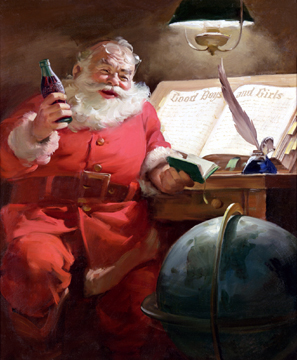
My parents never lied to me about Santa Claus. It may be difficult to convince some that this didn't hinder my fun as a child at Christmas, but it didn't. Though Mom and Dad were always straight with me and my siblings about Santa's nonexistence, we still got to "play" Santa Claus. We would sit on his lap at the mall, get excited when the news would show Santa's sleigh on radar, set out milk and cookies before going to bed, earnestly listen for jingle bells, and wake up to find presents in front of the tree that weren't there the night before--with tags on them that read "From: Santa Claus."
Was this play just as fun and magical for us as it was for those children who actually believed? I'm pretty sure that it was. Think about it: children play at things that aren't real all the time. One way is to pretend to do something that is based on reality, such as playing house or school. You couldn't possibly spoil a child's fun if you broke in to say "You know you're not a real mother" or "You know you're not a real teacher." The child would just think you were stupid, someone who's grossly missed the point. Another way to play is to pretend concerning something that is completely fantastic, such as imagining you're Superman or that you're chasing unicorns. Children know that Superman and unicorns don't exist, but it's still fun to pretend, and -- for a child -- imagination feels very real, even while being fully aware of actual reality. If you told a kid these imaginary things weren't real, you'd be the stupid fool, not them.

In elementary school, when most of my friends either believed in Santa Claus or were questioning their belief (as all children eventually do), they would ask me if I believed. Sometimes I simply said no, but my favorite answer was, "I like to pretend that he's real." As nearly any kid naturally would, I enjoyed the image and idea of Santa Claus. There's no reason to deny a child (or an adult) the mythology of Santa Claus, since it is possible to celebrate him without taking the next (stupid, foolish?) step of forcing belief.

Saturday, September 11, 2010

The Girl Who Cried Dragon

What if, instead of hearing the story of "The Boy Who Cried Wolf," someone told you the story of "The Girl Who Cried Dragon"? Instead of a boy who constantly lies that a wolf is attacking his sheep (only later for the lie to come true, when no one believes him), you're told a story about a girl who lies about a dragon who attacks the town's magic treasure? What would your response be? Would you think the story was nonsense because it wasn't how you were taught it? Would you knowledgably declare that dragons don't exist? Would you have a problem with the hero being female instead of male? Would you puzzle over the meaning of the magic treasure?

If you find these cosmetic differences in the two stories so big of an obstacle that you don't understand the basic moral -- namely that liars aren't believed even when they tell the truth -- then you're hopeless. But if you see why these minor changes in character, animal, sex, etc. don't affect the moral of the story one bit, then you can begin to understand the universal nature of myth and the language of God.

Friday, September 10, 2010

Rusty Consumes the Holy Books


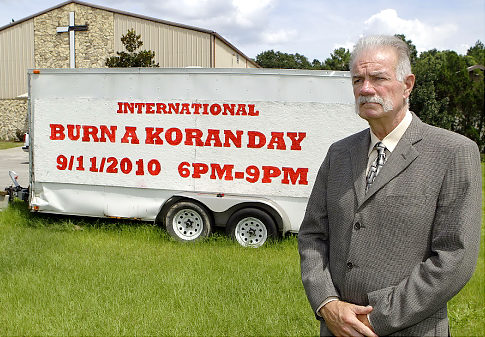
International Burn a Koran Day may or may not be held this Saturday. Whether or not it is, I figured I'd use the opportunity to treat holy books a little differently than Pastor Facialhair...


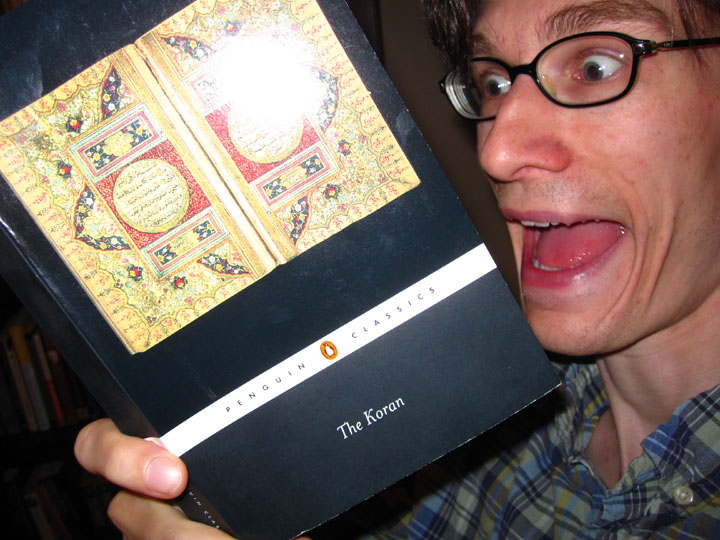
I started by reading the Koran rather than burning it. Boy, did I learn a lot! Did you know that Jesus is in it? Did you know that the god in it is the same god of Jews and Christians? It's part three of the Yahweh trilogy!

Sunday, August 22, 2010

HEADLINE: Citizens Angry at Landowner Over Dumb Misunderstandings

One of my favorite aspects of America comes from the very first sentence of the very first amendment of the US Constitution: "Congress shall make no law respecting an establishment of religion, or prohibiting the free exercise thereof." The idea of separation of church and state (which Jesus himself advocated when he said to give to Caesar what belongs to Caesar and to God what belongs to God) is a beautiful thing, allowing us to be a republic/democracy (not a theocracy) that protects your rights to be a Jew, Christian, Muslim, Hindu, Wiccan, Atheist, or someone who's completely indifferent to the entire god thing.

And yet, though this simple and beautiful concept would work in practice if we'd let it, often we don't. Growing up (in Mississippi, if you're curious, not that that means anything), we had prayer in public schools all the time. I don't really know what they were thinking. Most probably, they weren't thinking anything. I student-taught once at a place where they did prayer over the intercom system. The principal said to me something like, "We could get in trouble for doing this, but I think it's worth the risk." My memory is fuzzy, but I think she even said, "Everyone here is a Christian anyway." Not only would that be beside the point, but it's quite an assumption. When my public school prayed when I attended, I considered myself a Christian, too, but I hated that they prayed in a public school. I knew it was wrong. Even if most of us could be filed under the broad label of "Christian," I knew that they weren't praying to my god. The god I believed in wouldn't have liked what they were doing. Especially since I knew for a fact that some of my friends were non-Christians and Atheists and may have cared for forced prayer even less than I did. During these prayers, with "every head bowed, every eye closed" (as they commanded you), I looked around the room in an angry mini-rebellion. I sometimes caught eyes with others who were probably doing the same.

Then of course I got to hear nonsense my whole life like "Everything gone downhill since they took prayer out of schools," which happened -- you know -- in 1964, so that shows how outdated a statement like that was (not to mention that the Bill of Rights was ratified in 1791). Sometimes they'd go this far: "There's been another school shooting. Well, what do you expect when you take God out of the schools?" Which means, one must assume, that these statements were made by those who choose to worship a god who will murder innocent teenagers in the guise of a disturbed child with a shotgun (who now gets to spend the rest of his life in jail), just because he's upset that no one is talking to him during federally-funded education hours.

As I say, I don't know what people are thinking when they willfully combine church and state and impose their religion on others, but the sentiment sounds, to me, something like this: "Our ancestors came to America to flee religious persecution. The founding fathers included freedom of religion in the first amendment. That means that today every American is free to worship Jesus, and if any fuckers who believe in anything else want to do otherwise, I will eat the American flag and shit it down their pagan necks."

Sound demonic? It is.

This mentality is alive and well right now with the "controversy" over the Muslim community center (which is being built in order to improve Islam-West relations) being built several blocks from so-called "ground zero," where the World Trade Center used to be. I don't like to write about current events on the God Blog, and in a way I'm not, since this is just a manifestation of something that's been going on and will continue to go on: a continual struggle to uphold our constitutional right to freedom of religion.

Thursday, July 1, 2010

A Phrase To Avoid

Never say this again: "Well, I'm a Christian, so..."

There are a few reasons for this request. If you were to say, "Well, I'm a feminist, so I believe in equal rights for women," it might be okay, but even in this example you can see that it's redundant: you're just defining what a feminist is. You could just say "I believe in equal rights for women" and it would mean the same thing. Also, you don't believe in equal rights for women because you're a feminist, because you have this feminist label. You are called a feminist because you believe in equal rights for women. Similarly, when you say "Well, I'm a Christian, so..." you're mixing up cause and effect.

Unfortunately, you're not even being redundant if you say "Well, I'm a Christian." You're simply not communicating anything. Because the label Christian has no real meaning. You can hear that the word has no meaning when you listen to what comes out of different people's mouths after saying this phrase:

"Well, I'm a Christian, so I believe in the trinity."
"Well, I'm a Christian, so I don't approve of homosexuality."
"Well, I'm a Christian, so I am a member of the Republican party."
"Well, I'm a Christian, so I believe we need to do missionary work."
"Well, I'm a Christian, so I believe the Pope is infallible."

Et cetera.

You couldn't get all Christians to believe in any one of those things. I'm not sure that an umbrella definition for Christian exists, and there certainly isn't a shared belief system, in spite of some apparent similarities. (The best you could say, and be universal, is "Well, I'm a Christian, so I have some belief having something to do with Christ." Maybe.) So when you use this phrase, what you're really saying is, "Well, my version of Christianity forces me to believe this..."