Tuesday, March 26, 2013

A Father's Blasphemy

I can't walk into one of these empty places
Without thinking of Philip Larkin's "Church Going,"
And I certainly can't write about going to an empty church
Without Larkin's ghost poking me on the shoulder
And telling me, "I've already been here. Move along."
But I'm not moving along. I'm staying. I used to live here.

And so here we are: me and my daughter,
Who has only been walking on this earth a few months,
At the entrance of a church, a respite from downtown shopping.
She is banging on the baptismal font and laughing at the echo.
"You bang away, sweetheart," I tell her.
"You'll never have to be water-boarded in one of those things."

She runs from pew to pew, more giggling at novelty,
And I only make sure that she doesn't rip the hymnal pages.
Otherwise, I let her run free and sinless in the aisles
As I become distracted by wall paintings of Peter, Paul, and Mary,
Which remind me of the children's song "Puff the Magic Dragon,"
A bittersweet song about putting away nonexistent childish things.

After the baby grabs my finger to climb onto the platform,
She whacks and scream-laughs at the wooden pulpit.
In her size four purple Sauconys, she runs roughshod over this space,
Like a little trickster who knows she is defiling the sacred.
But it is her ignorance of sacrilege that pleases me most,
That odd word invented by penis-owning homo sapiens.

I imagine that my daughter will change the world one day.
I won't allow places like this to tell her that she can't.
I won't let them tell her that she needs a dead man to marry her
Or that to have a vagina is to be a second place human
Or that my sperm contained the gene for original sin,
Passed down to her along with my eye color and penicillin allergy.

When she lifts her arms for me to pick her up,
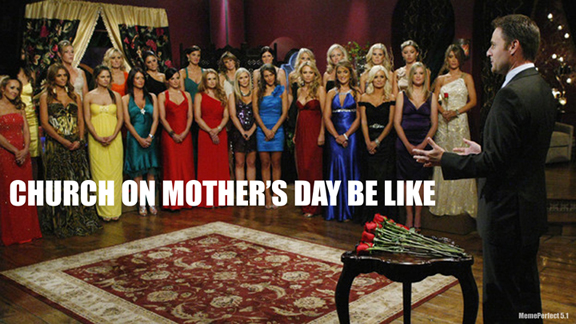
I think of those who will fill the sanctuary this weekend,
Crying and raising their hands, like babies in a crib,
Toward a father who isn't around or maybe has his headphones on.
As for me, I can pick up my girl, tell her I love her, and leave this place.
In this way, I'm a much better dad than certain folk I'm not allowed to name.

Wednesday, February 13, 2013

Catholicism Reboot: The Forty-Five Theses

Now that the pope is retiring, it's time to bring in some changes to the papacy and the Catholic Church in general to make it more up to date for the 21st Century. Here are my Forty-Five Theses. (Martin Luther had just under a hundred. I'll go just under fifty, since I know we have less time on our hands than they did in 1517, what with all the screen-based activities we have to do.)

1. The dogma of papal infallibility should be abandoned.

2. Bishops should be allowed to move in other directions besides diagonally.

3. In order to improve upon the other-worldly quality that Latin provides, the Mass should be performed in Klingon or Elvish.

4. Baptisms should be optional. Also optional in baptisms: the use of water. Green slime preferred, especially to attract the youth.

5. Popes should not be considered important political figures or otherwise have any political power.

6. Popes should be chosen at random: slips of paper with the names of all Catholics will be placed in the hat of the previous pope and pulled out by whoever is the current host of Let's Make a Deal.

7. Rather than believing in the trinity, the new doctrine should allow for a fourth person of God -- a female -- because that actually makes more sense. (If the word "Trinity" is something that wants to be kept, then simply remove the Holy Spirit from the lineup.)

8. Rather than white smoke announcing the election of a new pope, a firework that forms the shape of the robot from the 80s television show Small Wonder should be shot into the sky--because why the fuck not?

9. Any social works -- such as feeding the hungry, clothing the naked, visiting the sick, etc. -- should be recognized as something anyone can do without getting it all tangled up with the supernatural.

10. Anyone who finds the baby in a king cake no longer has to bring the cake the next year. Instead, they have to bring the condoms to the new Catholic swinger parties.

11. Priests should not be allowed to rape children. Any church authority who finds out about a child molesting priest should not consider themselves above the law and should turn over the criminal to the police, rather than moving them to another diocese where they can rape more children. This practice should, within a reasonable time, be thought of as "common sense."

12. On Ash Wednesday, instead of ashes, maybe some garlic shavings--which will have the added bonus of warding off vampires.

13. Transubstantiation -- the belief that crackers and wine served in communion are literally the body and blood of Jesus Christ -- should be replaced by a belief of things that happen in the real goddamned world.

14. Catholics should stop forbidding birth control and realize that allowing women control over whether or not they have babies is a sure-fire way to help solve the poverty problem. (Poverty should also be considered a problem, not a fetish object.)

15. Priests should be allowed to marry and otherwise engage in healthy adult sexual activities.

16. Catholics should be much more clear that the "immaculate conception" actually refers to the Virgin Mary being born without sin and filled with the "grace" given during baptism, that it does not refer to the virgin birth of Jesus. Once this clarification truly sinks in, this and similar doctrines should be abandoned, for fear of sounding like one is arguing over who would win in a fight between two comic book characters.

17. Women should be allowed to be priests. Men should be allowed to be nuns.

18. Nunsense should no longer be thought of as a musical that hilariously breaks the fourth wall.

19. Priests, bishops, etc. should begin dressing like artistic depictions of Jesus, not like Liberace.

20. Anointing the sick should be replaced with visits to a qualified physician.

21. Any pope who accepts the title, after chosen, should be immediately martyred. Any pope who refuses his title, after chosen, should decide a new, non-religious career path.

22. Lent should no longer be a creativity contest for what to give up.

23. The "Final Judgment" -- in which God decides who goes to Heaven, Purgatory, or Hell -- should be a game show in which Catholics can live out this fantasy doctrine, since it likely won't happen when they die.

24. The church should pay taxes, and at a higher rate than billionaires to make up for lost time.

25. Instead of Lent, Catholics should just think about spiritual things each time they clean the lint screen in their dryers.

26. Rather than wishing to go to Heaven, all Catholics should just go ahead and take that long, expensive vacation to another country they've been talking about for years.

27. Confession booths should become masturbation stalls for repressed priests.

28. The practice of confessing to a priest to be absolved of sin should be replaced with individuals taking responsibility for their lives and facing the consequences of their actions. In most cases, however, there should be no need to confess anything, since the concept of "sin" will be recognized as a human invention and a tool of oppression.

29. Marriage should be allowed only for same-sex Catholics. Men and women who want to marry will have to undergo what is known as a "genital-interlocking ceremony" and keep their union hidden from the public until they reach age 85, by which point it will be viewed as adorable.

30. Boys should no longer have to kneel in front of priests.

31. All sacred images, candles, crucifixions, stained-glass, and other beautiful objects should be given to museums, where Indiana Jones would prefer they be.

32. Rome should admit that it stole and worsened Christianity just as it stole and worsened Greek culture.

33. Prayers for the dead should only be allowed when the dead person specifically requests it. (Requests made while still living do not count.)

34. The church should admit that (for reasons that should be obvious) it has no business deciding matters of morality.

35. Catholic Schools should have a "Whack a Nun Day" during which schoolchildren hit nuns with rulers in memory of the days when nuns used to do that to children (which, if they still do, should be abandoned).

36. All Catholic dogma should be replaced by Lars Von Trier's Dogme 95 philosophy of filmmaking.

37. The Vatican should be sold off brick by brick and the money should be donated to charities aiding victims of childhood sexual molestation.

38. Catholics should, each time they want to say "God" or "Jesus" or the equivalent, replace it with a god they don't believe in, just to see how it sounds to the ear.

39. The pope should no longer be considered the successor of St. Peter.

40. St. Peter should no longer be considered "the first pope" or a saint or anything else special, since he seemed like one of the stupider disciples among many stupid disciples.

41. The Virgin Mary should heretofore be referred to as "The Sexually-Active Mary."

42. The priesthood should be dismantled, and Jesus should no longer be recognized as the son of God.

43. The Catholic Church should admit that it is not the "one true church" and should help elect a new "one true church" every four years (coinciding with the Olympics), starting with the Mormons.

44. The church should apologize one more time for that Galileo thing.

45. All Catholics should become Protestants, try that out for a year, dabble in Buddhism (preferably during a year off after college), and then realize it's just as well to become secular and live a real life.

Sunday, November 4, 2012

A Mardukian Nation

I have already explained why Marduk of Babylon is the ultimate god and why everyone should believe he exists. I have already explained why the Enuma Elish is the ultimate authority on the creation of our world, the creation of humanity, and Marduk's power, making it a very clear blueprint for how we should live our lives.

But did you know that the "God" referenced so often in the government and culture of the United States is supposed by many to be some other strange god? For this reason, I propose (below) some changes that will make the god we are meant to be worshipping absolutely clear.


Wednesday, October 17, 2012

Demons!

Growing up with God is often rough enough, but I also had the opportunity to grow up with his evil counterparts: the Devil and his evil underlings. In a lot of ways, demons were more real to me than God. God never spoke to me, but evil spirits did, and they manifest themselves in a variety of ways, while God never quite managed to solidify as even one satisfying image in my mind. And devils might show up anywhere, during almost any time.

In the very early days, I didn't put as much stock in the supernatural (not counting God, of course) as some of my immediate family. Perhaps it's because didn't watch horror movies, knowing they would scare me. My brother, however, would wake up in the middle of the night to see some little green hobgoblin jump into our chest of drawers. Or he would open his eyes and see Freddy Krueger sitting in our desk chair, right next to our bunk beds, menacingly curling his bladed glove. My sister's visions were even more odd, since they involved seeing me walking through the hallway or hearing my voice in her ear when I was -- in reality -- in the other room sleeping.

As for myself, I've always been able to open my eyes at night and see all kinds of visions: as a kid, little hopping gnomish creatures would appear and -- today -- spiders. I once woke up screaming, thinking our cat was clawing me, and it took a long time to convince me that the cat was outside, since -- even while this was being explained to me -- I felt the pain of claw marks on my skin. But I knew enough about dreams back then to know that that's what they were: nightmares, waking dreams, mind tricks.

Unfortunately, however, simple childhood dreams, in my house, were often given immense power through the backing of religion. (And no wonder, since religions are based on dreams.) Sometimes, luckily, nightmares were quickly and lovingly dismissed as "just a bad dream," but -- other times -- they were not. The Freddy Krueger episode, for example, did not lead to a speech about how maybe my brother shouldn't watch scary movies if he couldn't handle them at age fifteen. Instead, it led to a speech about how God was more powerful than the Devil and that our family, with God's power, could defeat him. I was nine years old and this was happening in my bedroom. I was learning not only that the Devil could bother you at night, but he could do so in the form of a cheesy movie character. I woke up annoyed at all this commotion in the middle of the night, but by the end of the overheard conversation, I was certainly leaning toward the idea that this could be real.

One does not always become more rational or intelligent as one grows up and -- sure enough -- I did eventually buy into the idea that demons existed, even if I could still distinguish dreams (and movies) from reality. Unclean spirits were in the Bible, so I pretty much had to believe in them. So what did I think I was dealing with? The usual: fallen angels. God created angels before he created humans. Lucifer rebelled against God and he became Satan (just as Milton told us). He gathered other angels to his side and, together, they became very interested in sticking it to God by tormenting his beloved humans, looking for bodies to possess and souls to thwart before one day -- at the end of time -- they would be cast into the Lake of Fire.

Thursday, September 6, 2012

The Martyrs

A friend of mine told me a dream he had:

"I was in church and a man burst in with a gun. He walked right up to an elderly saint, someone I always figured was ready for Heaven, held a gun to her head, and said, 'Deny God or I'll pull the trigger.' She smiled and said, 'That is something I could never do,' so he killed her, her brain flying out of her skull."

"I think I've heard this one before," I said, but he continued:

"Next in the dream, the shooter found a person in the church who I considered 'lukewarm' where Christ was concerned, on the fence about his faith. 'Deny God or I'll pull the trigger,' the shooter said. The man hesitated for a moment, then -- though he seemed nervous about it -- said, 'No, I can't deny him.' So his bloody brain ended up everywhere too. I knew that he had finally made the correct decision and that he immediately went to Heaven. Everyone in the church was slaughtered in the same way: they wouldn't deny God and they were killed for it. Then suddenly, in the dream, I was at a convention for atheists..."

"Ah, here comes the punchline," I said.

"This isn't a joke. It's a dream," he said. "The gunman walked up to the keynote speaker and held the gun to his head. To him, he said, 'Say that you believe in Jesus with all your heart or I'll kill you.' The atheist actually laughed a little, but then repeated the words, as if to humor the gunman. 'Again!' the gunman screamed, so he said it again: 'I believe in Jesus with all my heart.' 'Again!' 'I believe in Jesus with all my heart!' Then the atheist started sobbing, saying, 'I believe in Jesus with all my heart, with all my soul, and I give my life to him!' Everyone at the convention began sobbing, repenting, and professing, and the killer opened fire on them all, a bloody massacre, sending them immediately to Heaven. It was like God's mercy. Then, in the dream, I was alone... just me and the man with the gun..." He stopped.

"Yes?"

"Eh, the rest of the dream isn't important. Never mind."

"C'mon. Tell me."

"Well, the truth is, the dream ended there. The man held the gun to my head, he told me to deny God or he'd pull the trigger. But before I had the chance to say anything, I woke up in a puddle of come."

Thursday, August 9, 2012

Adam and Steve

I think I finally figured out why people keep saying "God created Adam and Eve, not Adam and Steve." It's so clear to me now, as it should have been all along: it was right there in the book. Yes, Adam and Eve.

God doesn't want anyone to get married whose names aren't Adam and Eve. These are the only two name pairings that God wants. It's traditional marriage!

So is your name Adam? Then you can only marry a person named Eve. Is your name Eve? Then you can only marry a person named Adam. Is your name neither Adam nor Eve? Sorry, you can't get married... unless you want to offend God.

I know this inconveniences a lot of people, but the Bible is pretty clear on this. For a long time now, this garden story has been held up as the example for how we should live our lives, whom we should marry, how we should treat women, the importance of obeying our parents, the existence of original sin, and many other things. But it's time to stop overlooking the obvious: wedding registries at Williams-Sonoma are for Adams and Eves only.

Either that, or the Bible forbids all marriage except between males who were created from dust and women who were made out of those males' ribs. Also a possibility.

Tuesday, August 7, 2012

The Tao of Jesus: A Spiritual Analysis of the Gospel of John

"There was something formless and perfect before the universe was born. It is serene. Empty. Solitary. Unchanging. Infinite. Eternally present. It is the mother of the universe. For lack of a better name, I call it the Tao. It flows through all things, inside and outside, and returns to the origin of all things." --Lao Tzu, Tao Te Ching

CHAPTER 1

The Word

Heinrich Zimmer said (as Joseph Campbell was so fond of quoting) that the best truths can't be spoken and the second-best are misunderstood. This quotation sums up my spiritual analysis of the Gospel of John (and I'm afraid this is going to be one of those essays in which the thesis is stated over and over again with different examples). The Tao is the name for the former (can't be spoken, beyond all words) and Jesus' words are the latter (misunderstood, attempting to express inexpressible through metaphorical words and actions).

To explain what I mean, I'd like to walk us through the book of John, the most spiritual of the gospels, beginning with its cryptic opening:

"In the beginning was the Word, and the Word was with God, and the Word was God. He was in the beginning with God. All things came into being through him, and without him not one thing came into being. What has come into being in him was life, and the life was the light of all people. The light shines in the darkness, and the darkness did not overcome it."

You can see already that we're dealing with concepts that are difficult to explain with words. It is no accident that the word Word (sometimes translated as Logos) is used, as both a proper name and a concept, attempting to explain what Jesus is, re-writing (or at least clarifying) Genesis to declare that "in the beginning" Jesus created the world and was apparently the subject of "Let there be light." And lest we begin thinking that these things are physical (and how can they be, since the Word is described both as being "with God" but also God himself?), John writes that those who accept the Word/God become "children of God, who were born, not of blood... but of God." So we're not talking about bodies. We're not talking about "the world" as a planet. We're talking about the inner life, otherwise known as the spiritual life.

On the other hand, John is constantly blending these spiritual words with things that are "worldly" indeed. Jesus Christ is a specific, presumably historical human in this book, and -- throughout -- Jesus can't seem to decide if he's a full-blown Taoist guru attempting to explain the unexplainable or if he's a reformer of Judaism, beholden to those traditions while desiring to make them less dogmatic and more spiritual ("The law indeed was given through Moses; grace and truth came through Jesus Christ"), even if it requires him engineering his own literal and metaphorical death.

The schizophrenia of this book might be due, in part, to the retro-fitting of the more established Christian religion (this book wasn't finished until about 100 years after Jesus lived, and of course everything was gathered second-hand, at best) into what may have once been a more pure Toaist-like (or at least Eastern or mystical) teaching, one in which "God" is not an actual entity but only a symbol of the transcendent, a name to help us experience things we can't understand. But, tempting as it is to use this to explain the inconsistencies in Jesus' teaching (Western vs. Eastern, legal vs. mystical), I have to admit that Jesus seemed to have his feet in both worlds: the spiritual and the literal/physical/historical. So I will tackle both as they occur.

If you want to see what a pure version of Taoist teaching looks like, look at the first chapter of Lao Tzu's Tao Te Ching: "The tao that can be told is not the eternal Tao. The name that can be named is not the eternal Name. The unnamable is the eternally real. Naming is the origin of all particular things. Free from desire, you realize the mystery. Caught in desire, you see only the manifestations. Yet mystery and manifestations arise from the same source. This source is called darkness. Darkness within darkness. The gateway to all understanding."

Note the similarities but also the contrasts between this and the opening of John. "God" may be a good simile for the Tao, but John claims that the Word/Jesus is God, something named, something that "can be told." And while Lao Tzu says that darkness within darkness is the gateway to all understanding, John says that the Word defeats this darkness by being the light. One offers truth only through a passive uncertainty, while the other offers truth through a rather specific entity. One thing is agreed upon by the two sources, however, which is that the Word did create everything, since "naming is the origin of all particular things." Before the Word, there was the Tao (a name for the unnamable), and nothing but it, but through the Word came everything else.